
Press coverage
Hi, Cousins!
Read the original article at Lëtzebuerger Land →
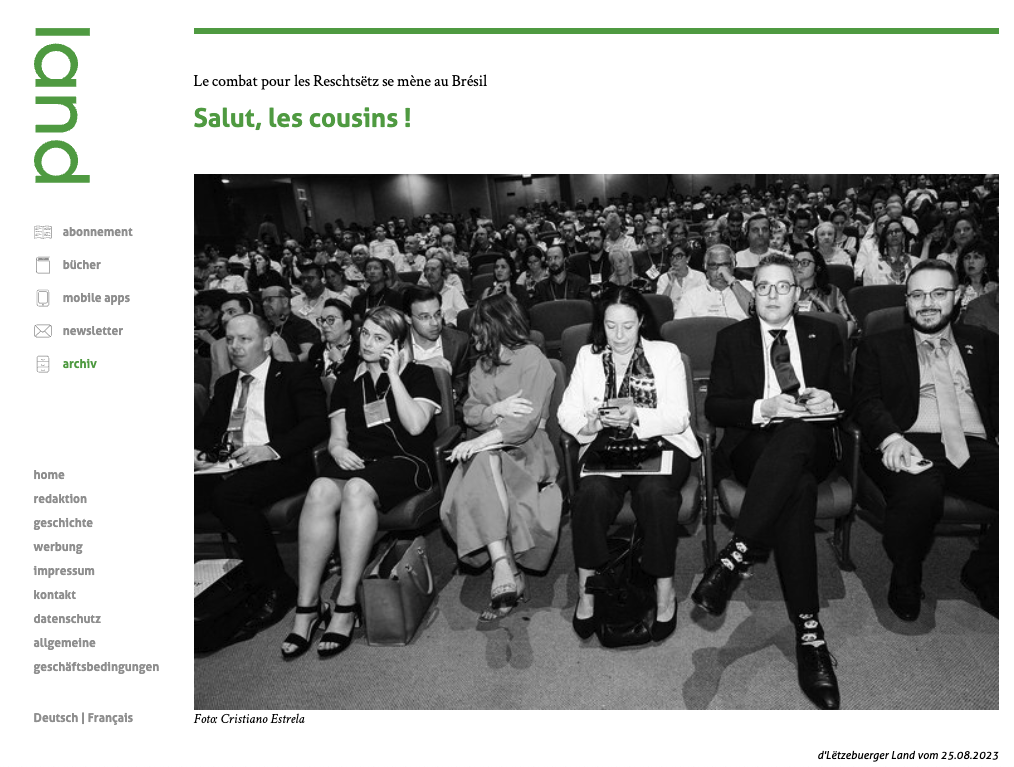
Featured in d’Lëtzebuerger Land, LuxCitizenship founder Daniel Atz contributed to an article exploring the cultural and legal ties between Luxembourg and its global diaspora — particularly Americans reclaiming citizenship through ancestry.
The article, titled “Hi Cousins!”, dives into the history of Luxembourg emigration, the 2008 nationality law, and how thousands of Americans have successfully reconnected with their Luxembourgish heritage. Daniel shared how his work at LuxCitizenship has played a pivotal role in helping descendants of Luxembourg emigrants navigate the complexities of dual nationality and rediscover their European identity.
The story also highlights the emotional and cultural dimensions of these applications — showing that this movement is not just bureaucratic, but deeply personal for many.
👉 Read the original article on Land.lu (German): DEU: Luxembourg auf Wachstumskurs – günstige Perspektiven für Immobilien und Wirtschaft →
English Translation
Hello, cousins!
Luxembourg politicians at an electoral meeting in Florianópolis, early April
d’Lëtzebuerger Land of 25.08.2023
“ The success of Luxembourg, it is the success of the CSV; because we have shaped a large part of the history of the country. There, now I have campaigned…”, says Isabel Wiseler-Lima, this Monday evening in an administrative center, in the heart of Florianópolis. Around forty Brazilian-Luxembourgers came to listen to the CSV MEP and her spouse Claude Wiseler talk about the “segredos dos sucessos do Luxemburgo”. The husband gives the usual overview on the Standort: short paths, multilingualism, political stability. “The most important elections for us take place in October, otherwise we would not have come here on vacation,” jokes his spouse. Strange “vacations”. The Wiseler couple lined up five meetings in four days, visiting the states of Santa Catarina, Paraná and São Paulo. Every vote counts. The Wiselers push the campaign even into the small banana town of Luis Alves. Brazil would count 26,743 Luxembourgers, according to the National Register of Natural Persons. During the conference in Florianópolis, the honorary consul Karen Francesca Schwinden takes the floor to explain that at the moment of voting, “we should take into account the candidates who made the effort to come here”.
Frank Engel had passed shortly before. During five days, the head of the micro-party Fokus lined up meetings with officials of Paraná and Santa Catarina, the two southern Brazilian states that concentrate the most neo-Luxembourgers. His interlocutors, Engel recounts to the Land, would above all have been interested in concrete matters, such as economic, sports or university partnerships. “They ask themselves: Wat hu mir vun der Staatsbiergerschaft? Wat heescht dat konkret?” In his electoral program, Fokus proposes to reserve “two or three” seats in the Chamber for Luxembourgers abroad. The election of these deputies (Engel now speaks of four) should be done on a dedicated list with individual candidacies. Does the ethnic logic of recovery not pose a problem to him? He could certainly understand that becoming Luxembourgish “because the great-grandfather had a Luxembourgish shepherd dog” could disturb, Engel replies. But that would be to forget that neo-Luxembourgers have spent a lot “of effort and money” to reconstruct their “particularity”.
The breach was opened by the nationality law of 2008. It allowed distant descendants to “recover” nationality, on condition of finding a great-great-grandfather/mother who had been Luxembourgish in 1900. At the moment of the vote, this “particular transitional provision”, planned for a duration of ten years, passed unnoticed. It was Luc Frieden who had introduced the law as Minister of Justice. “As far as I remember,” he recounts this week to the Land, the recovery would have responded to the wish “fir och erëm Lëtzebuerger ze ginn” that would have been expressed by Belgians of the Province of Luxembourg, whose ancestors had been Luxembourgish. The remedy against the phantom pain of the “dismemberments” produced unexpected side effects. In the Tageblatt, the researcher Denis Scuto recently pointed out “the irony of history”: “This measure with romantic, even ethnic undertones (…) opened the door to a second opportunistic nationality, called strategic, a ‘Premium Citizenship’, at the time of globalization and of great inequalities between continents.”
With now some 130,000 “Auslandsluxemburger”, the “recovery 1900” weighs like a mortgage on the electoral process. (For reminder: the Centre constituency counted only 73,000 voters in the last legislative elections.) In 2018, the rush did not take place. In total, 1,078 postal votes had then arrived at the Cercle Cité, office where, by default, vote the neo-Luxembourgers who have never resided in the Grand Duchy. But these ballots also included those of former Stater: students, expatriates or new cross-border workers. The neo-Luxembourger voters therefore must not have exceeded a few hundred, at most.
For the 2023 election, the registration deadline runs until next Wednesday. The Pirates estimated that, this time, between 2,000 and 3,000 neo-Luxembourgers could participate. “Not 10,000, but not a few hundred either,” says the deputy Sven Clement. An administrative decision has just cut in half the number of potential voters. At the beginning of the month, voters by correspondence abroad received a letter from the Ministry of State informing them that they had to attach to their request a simple copy of their “Luxembourg identity card or passport”. Now only half of neo-Luxembourger Brazilians have these documents. They thought they could vote with their identity papers of the Federative Republic of Brazil.
Sven Clement sees his future seats in danger. Facing Contacto, he denounces “a political maneuver to prevent voters from exercising their constitutional right to vote”. “Mir wëssen, wéi knapp Reschtsëtz ausfalen…”, he says to the Land. “It can be decided by less than 200 votes. If two to three hundred voters were excluded (and still this is a very low estimate), an administrative decision would end up influencing the elections.” He says he has spoken to concerned people who would be ready to “clarify” the question before the courts. He recalls that the City of Luxembourg already has proof of citizenship, since it is it that delivers nationality certificates. As for the electoral law, it simply stipulates that a voter domiciled abroad must present a copy of “his identity card or his passport valid”, without specifying whether these documents must be Luxembourgish or not.
One week before flying to Brazil, Claude Wiseler attended the “Luxembourg Fest” in Belgium, Wisconsin, famous for its “World’s Largest Träipen Eating Contest”. Without surprise, he met there Sven Clement, but also his party colleague Michel Wolter. During thirteen days, the deputy-mayor of Käerjeng organized a trip across the American Midwest, which he documented extensively on Facebook under the title “Mich goes to America”. A sort of genealogical pilgrimage in search of distant cousins of New Ulm and New Trier. “Hei leien bestëmmt esou vill Lëtzebuerger wéi um Kierfecht zu Käerjeng”, meditates “Mich”, while walking through yet another cemetery. Wolter is above all proud to be recognized as “brewery-mayor” in certain American towns: “D’Bofferdings-Brauerei an hire Béier sinn eng Institutioun”. So much camaraderie leads the CSV politician to imagine an ideal community: “Overall, that Luxembourg, which Luxembourgers from America embody, was more Luxembourgish than Luxembourg itself. Or something like that.”
The diaspora in Brazil would be more concentrated and better structured than that of the United States, estimated Claude Wiseler this Monday upon his arrival in Florianópolis. Paradoxically, this is due to the fact that emigration to Brazil in the 19th century was a gigantic fiasco. Some 2,500 Luxembourgers (that is 1.8 percent of the population) tried to reach Brazil in 1828. Two-thirds returned empty-handed, deeply in debt and covered in ridicule. Swindled by travel agents, these “Brasilienfahrer” did not even manage to embark, finding themselves stuck in Bremen. A few rare fortunate ones succeeded in the crossing. Which explains that neo-Luxembourgers of Brazil often share the same family ancestry; thousands of distant cousins. Born in 1808 in Oberfeulen and died in Rio Negro in 1877, Nicolas Bley would today have 15,000 descendants, tell the Luxembourgish Brazilians. In 1979, the progenitor had the right to a monograph titled Genealogia da Família Bley, which has just been reissued in 2023. It would have “served as a basis for the acquisition of Luxembourgish nationality by many descendants,” notes the newspaper Bem Paraná.
Created in 2019, the Association of Luxembourgish Citizens of Brazil (ACLux) is a hybrid between Rotary club, lobbying group, political platform and unofficial embassy. The region where neo-Luxembourgers are concentrated is very white, very wealthy and very right-wing. In the last elections, Jair Bolsonaro obtained 62 percent in Paraná and 69 percent in Santa Catarina. Bringing together mainly lawyers, doctors, architects and civil servants, ACLux is representative of this upper class, for which a European passport is as much a sign of distinction as an insurance. The association is well connected with the political elite. The Legislative Assembly of Paraná thus counts two deputies of Luxembourgish nationality. In Brasília, ACLux tries to convince the federal government to open an embassy in the Grand Duchy, relying on the senator Esperidião Amin, a political heavyweight from Santa Catarina.
But ACLux also exerts pressure on the Luxembourgish political environment. On April 1, the association had its moment of glory. In the middle of the municipal campaign, it succeeded in bringing to Florianópolis representatives of five political parties for a large electoral meeting. These had long hesitated, proposing to pass by a Zoom conference. ACLux insisted. The parties consulted each other, and ended up following the invitation. They were above all pushed by the fear of being overtaken by the Pirates. (Two parties did not make the trip: the DP for ecological principle, Déi Lénk for lack of means.) Once in Florianópolis, the Luxembourgish guests quickly felt limited to the role of extras in a spectacle dominated by Sven Clement.
The Pirate deputy arrived on conquered ground. It was his third visit to the state of Santa Catarina. He had been the first to discover this reservoir of votes and to integrate it into his electoral strategy. In March 2021, Clement submitted a bill to extend until 2030 the recovery provision. (This officially ended in 2018, but candidates have until the end of 2025 to complete their file and present themselves at the Biergercenter.) Praising the “hereditary of Luxembourgish culture” and “the link that unites them with the land of their ancestors, their land,” the Pirate bill sometimes took on a völkisch coloration. Only ADR deputies let themselves be convinced by this logic, recognizing in it a consistent application of “ius sanguinis”.
On their lists, the Pirates present the former vice-president of ACLux, Roberta Züge. Upstream of the April colloquium, it was she who handled preparations on behalf of the Luxembourgish-Brazilian association: “I spoke with all the parties and I handled the Facebook group,” recounts the distant descendant of Nicolas Bley (“the great-great-grandfather of my mother”), settled for three years in the Grand Duchy. A few months ago still, she passed for a neutral arbiter. In mid-July, she displayed the colors of the Pirates. The ACLux committee would have been “surprised,” she says: “There are people who say that it is not good for the association.” She assures having resigned from the committee of the association and no longer participating in meetings, even if she still appears as “director of communication” on the ACLux website. Züge speaks of a “very difficult decision”. She would have reflected on it for two weeks and would have only decided the day before the presentation of the lists. Züge describes herself as “very in the center”, she would be “neither pro-Bolsonaro nor pro-Lula”. She sees in the Pirates an organization “young and open”, contrary to the big parties in which one could “not touch the questions”.
On October 8 it will be her 51st birthday. If she were elected to the Chamber, she would bring other experiences into it: “Most deputies are born here. They do not really know the problems of integration, whereas that, I know them”. Züge refers to her own path and to her difficulties to have her veterinary diploma recognized: “I only had my authorization after fifteen months. I believe it was discrimination”. In Brazil, Züge worked in the dairy sector, dealing with official certification and sanitary control. In Luxembourg, she would not have “a real network”, even if she would already have established contacts with Luxlait and Fair Mëllech. Since March, the Pirates also employ the former “social media manager” of ACLux, Danielly Kaufmann. The Luxembourgish-Brazilian is currently making a documentary on the two Pirate deputies and their staff: “But I never became a member of the party, I’m a contracted artist with this challenge of creating on demand”, she specifies. A film to the glory of Sven Clement? “No, she has carte blanche,” assures the latter.
Out of the some 18,000 Brazilian neo-Luxembourgers of voting age, how many actually intend to vote? The founder of LuxCitizenship, Daniel Atz, who offers administrative and genealogical services to candidates for recovery, has just published a “survey” on the question. 634 Luxembourgish Brazilians filled out the questionnaire, of which about one quarter say they want to vote. Now, the survey presents a strong statistical bias: it circulated mainly on social networks, shared and promoted by neo-Luxembourger associations. However, it remains that, at the beginning of April, no less than 460 people had come to the “Teatro Governador Pedro Ivo” of Florianópolis to listen to the presentations of Luxembourgish politicians. And this for eight hours. During the interludes, children in Dirndl and Lederhosen danced the Schuhplattler in honor of the Luxembourgish guests, astonished by so much cultural hybridization.
.