
Press coverage
Election in Luxembourg this Sunday (8th) includes Brazilian voters and candidate
Read the original article at CNN Brazil →
This article is coverage of LuxCitizenship’s research and client work; it cites the company’s findings on Luxembourg’s dual-citizen community rather than naming Daniel Atz personally. LuxCitizenship is the citizenship-by-ancestry firm Daniel founded in 2016.
English Translation
Election in Luxembourg, this Sunday (8), has Brazilian electorate and candidate
Increase in the number of Brazilians with Luxembourgish dual citizenship drew attention of political parties
Salma Freua, from CNN 08/10/23 at 04:00 | Updated 10/10/23 at 14:31
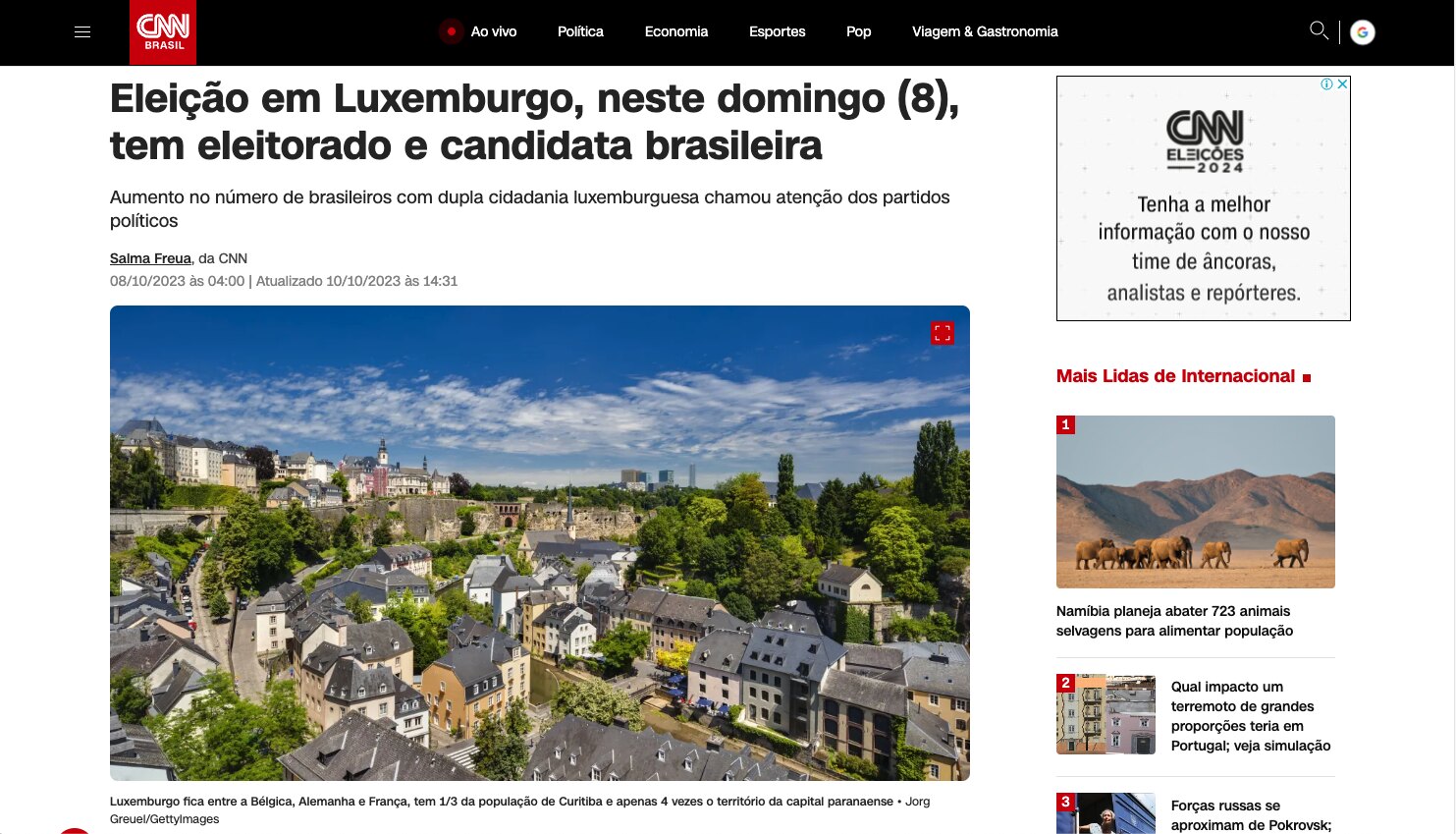
Luxembourg is located between Belgium, Germany and France, has 1/3 of the population of Curitiba and only 4 times the territory of the capital of Paraná
listen to the news
About 10 thousand kilometers is what separates Florianópolis, in Santa Catarina, from the city of Luxembourg, capital of the European country of the same name. Despite the distance, currently, the capital of Santa Catarina hosts thousands of Brazilians with Luxembourgish dual nationality.
They are citizens of Luxembourg who – in most cases – never lived in the country. Some never went to Luxembourg, and do not even intend to establish themselves there. The majority also never met a relative who was born in the country.
This population is not only in Florianópolis. Throughout Brazil, the number of Brazilians with Luxembourgish dual nationality has already surpassed the mark of 27 thousand – which represents around 4% of the population of Luxembourg, a country of only 665 thousand inhabitants.
In September of this year, Brazil surpassed Belgium and became the second largest country in number of Luxembourgers abroad. It is behind only France, which has 32,640, and ahead of Germany, which hosts 20,260 Luxembourgers, according to the most recent statistics of the government of the Grand Duchy of Luxembourg.
While Brazil is thousands of kilometers from Luxembourg, these three countries border the Grand Duchy, and have even dominated the current Luxembourgish territory in past centuries.
In addition, due to the territorial proximity of Luxembourg with Germany, Belgium and France, thousands of people – including Luxembourgers – live in these countries but work in Luxembourg.
What explains the atypical quantity of Luxembourgers in Brazil is a law that was in force from 2008 to 2018 and made more flexible the obtaining of Luxembourgish nationality. Before, it was possible to obtain citizenship only from a paternal lineage.
The new law allowed that maternal lineage also be considered, provided that the Luxembourgish ancestor was still alive on January 1, 1900.
The migratory movement of Luxembourgers to Brazil happened mainly between the 19th and 20th centuries. In the same way as other Europeans, such as Italians and Germans, they came in a scenario of reduction of the slave trade in the world, end of slavery in Brazil and crises in Europe, which caused this labor force to establish itself in Brazil, with emphasis on Santa Catarina.
Throughout this year, almost two centuries after the beginning of this migratory flow, Luxembourgish politicians moved to Florianópolis, Curitiba and São Paulo to present themselves to a new electorate. In an event in April, six of the seven parties with representation in parliament participated in a congress with around 600 Brazilian-Luxembourgers.
Upon becoming Luxembourgish citizens, Brazilians by birth came to be able to decide the political future of Luxembourg and entered the radar of parties.
Elections
The legislative elections of Luxembourg take place this Sunday (8). The country is the last grand duchy in the world and a representative democracy in the form of a constitutional monarchy. Grand Duke Henri is the head of State of the country, while the prime minister is the head of government.
In these elections, the most important of the country, all the 60 parliamentarians of the Chamber of Deputies of Luxembourg are elected by the population. The largest coalition – formed between the parties after the election – usually elects the next prime minister.
One of the most likely for the position is the current prime minister, Xavier Bettel, who has been in power since 2013 and can be reconducted for five more years. He is from the PD (Democratic Party), of liberal tendency, and in 2015 became the first gay leader of the European Union to marry.
The country, however, never had a woman as prime minister. Paulette Lenert, from the LSAP, socialist party, may be the first.
Luc Frieden, from the CSV, also has chances to assume power. He is from the Christian party, which has the largest number of seats in Parliament currently, but is not part of the government.
Polls indicate that the number of seats of the party should decrease, from 21 to 19, but the conservative party should still remain as the largest in number of seats.
Brazilian electorate
Brazilians by birth will now be part of the decision. In the last legislative elections, in 2018, there were fewer than 3 thousand Brazilians with Luxembourgish dual nationality who lived in Brazil. Today, there are more than 27 thousand – an increase of more than 1,000% in 5 years.
The data are from the National Register of Natural Persons (RNPP) of the Government of Luxembourg. The RNPP does not publicly disclose what percentage of Luxembourgish citizens living abroad are adults. According to research by LuxCitizenship, a company that assists people with Luxembourgish citizenship in the Americas, approximately 70% of the 27 thousand, that is, almost 19 thousand, are over 18 years old – minimum age for voting in Luxembourg.
According to government data, 283,879 Luxembourgers can vote in these elections. If all adults with dual nationality in Brazil participated in this election, this would represent around 6% of the electorate of the country.
However, only 188 requested to participate. Valberto Césio May, 53 years old, is one of them: “I think that citizenship becomes complete with my participation in the electoral process,” said to CNN the architect and urbanist, who is also president of ACLux (Association of Luxembourgish Citizens in Brazil), headquartered in Florianópolis.
For him, voting in the elections of the country makes him feel effectively a Luxembourgish citizen and that his citizenship is not only a “simple document”. “From the moment that I am a citizen, I can exercise my rights and duties. And I think that this is also part of our integration,” he completed.
He obtained his citizenship in 2018, from a male lineage. Although this ancestry was already accepted before, with more restricted conditions, he said that with the new law, the possibility of becoming Luxembourgish became more known by people, including him.
The architect has already been to Luxembourg three times, but never lived in the country and does not intend to move there. One of the reasons is already being professionally established in Brazil. “The fact that I am not living there does not mean that I cannot be participating in this,” he reinforces.
Clash
But May is part of a small group that will be able to vote in these elections.
In addition to there being a deadline for requesting voting by mail, the only category allowed abroad, which prevents those who obtained nationality more recently from participating in the election, a decision of the Ministry of Foreign and European Affairs established the need for expatriates to present a Luxembourgish passport or identity document to vote.
According to research by LuxCitizenship, only about half of Brazilian-Luxembourgers had a Luxembourg passport or identity card.
Also according to the research, if only those who showed intention to participate in the election are considered, only 11% of Luxembourgish citizens residing in Brazil intended to vote in the legislative elections and possessed a Luxembourgish passport.
Upon acquiring nationality, the person receives a certificate guaranteeing the acquisition of citizenship. The issuance of an identity document, however, is not automatic.
To obtain a passport, the Brazilian with dual nationality must travel to the Embassy in Brasília, in addition to waiting for a bureaucratic process that can take up to 10 months, according to reports.
The decision of the government is contested by Roberta Züge, 50 years old, first Brazilian candidate to the Parliament of Luxembourg, according to the local press.
Brazilian candidacy
For Züge, the measure was imposed as a way to block votes from abroad. “People do not accept the idea that someone from the other side of the ocean can vote in the country, despite being a right,” she said to CNN.
According to article 64 of the Constitution, to be a voter in the country, it is necessary to be Luxembourgish and be at least 18 years old on the day of the election. The Charter prohibits voting in the case of a court restricting this right, in the cases provided by law, and does not mention the need to present a document.
Some Brazilians formally contested this requirement. The government’s response was that article 170 of the electoral law modified of February 18, 2003 establishes that “any person domiciled abroad must present a copy of their valid identity document or passport”. However, the law does not specify that the document has to be Luxembourgish.
It was in the determination of the ministry, this year, that this was added.
Sought by CNN, the Embassy of the Grand Duchy of Luxembourg in Brasília reinforced the need for a passport to participate in the election.
The candidate also spoke about the delay to obtain the document in Brazil.
“The treatment that is given to Luxembourgers abroad is very unequal. People are taking around 10 months to obtain a passport with the embassy. In Luxembourg, it is possible to obtain it in less than one week,” she said.
CNN questioned the Ministry of Foreign and European Affairs of Luxembourg about the delay in the process and awaits response.
“Many people had requested the document at the beginning of the year and will not be able to vote, because it did not arrive in time,” pointed out the candidate.
With Brazilian first name and German surname, Züge was born in Santo André, in the ABC Paulista, and is daughter of parents from Santa Catarina. She also lived in Recife and Curitiba before moving to Luxembourg, in 2020, after obtaining her citizenship in 2018, through a maternal lineage.
Another demand of the candidate is a more transparent and equal process in the validation of university diplomas in the country.
Veterinarian by the University of São Paulo (USP), she says that she obtained authorization to work in the field after almost two years “of fight”. “I have a master’s degree, doctorate, all diplomas with equivalence, and they did not even respond to me”.
She says that this struggle, publicly shared, gave her visibility. “I ended up gaining visibility because of the barrier that they created out of pure prejudice”.
“There is a lack of professionals. And at the same time that this shortage exists – there is a lack of doctors, for example – there are all these barriers in relation to diplomas issued in Brazil,” and she completes: “this is one of the demands that need to be included, not only for us from Brazil”.
She also intends to fight for equal treatment in obtaining citizenship. The law that boosted recognition of nationality opened a window of only 10 years for the request of Luxembourgish nationality for those who had a maternal lineage.
This request is the first phase of the process, which ended in 2018. With this, those who did not make this request, and have only ancestry through women in the family, can no longer try for citizenship.
The same does not happen with those who have paternal lineage. They continue to be able to request recognition of nationality.
In addition, descendants of female lineage need to go to Luxembourg to sign citizenship. This is the second phase of the process, whose deadline was extended from 2020 to 2025, due to the pandemic. Those of male lineage do not need to travel.
“This is even a question of justice, even more so me being a woman. I think it is such a glaring unequal treatment that this needs to be corrected,” contests the candidate.
The party to which she is running – the Pirates – tried to reopen another window of 10 years, but only the two deputies of the party voted in favor of approval of the measure.
Züge also defends improvements in the integration programs of the country. Beyond the question of dual nationality and immigration, she stands out in the party in health issues, due to her training.
The Pirates, centrist party founded in 2009, bets in this election on candidates of Lusophone origin. Of the 60 candidates, three are of Portuguese origin, two Cape Verdean, and one Brazilian – Roberta, who is also the only one born abroad.
Predictions indicate that in these elections the party may reach five or six seats.
Luxembourg has three official languages: French, German and Luxembourgish. The latter is used in debates in Parliament. If elected, the Brazilian will need a translator to accompany her in the sessions, since she does not yet master the language.
Even so, Züge has support from Luxembourgers, in addition to Brazilians. There is an expressive number that lives in Luxembourg, with around one thousand being able to vote in these elections, according to estimate of LuxCitizenship.
But according to the candidate, she is receiving help even from Brazilians who cannot participate in the election.
When she still doubted whether she should accept the invitation of the party to run, she heard from a Brazilian: “this invitation is not yours, it is ours. It represents our community”.