
Press coverage
On the trail of Luxembourgers across the Atlantic
Read the original article at Data.Public.Lu →
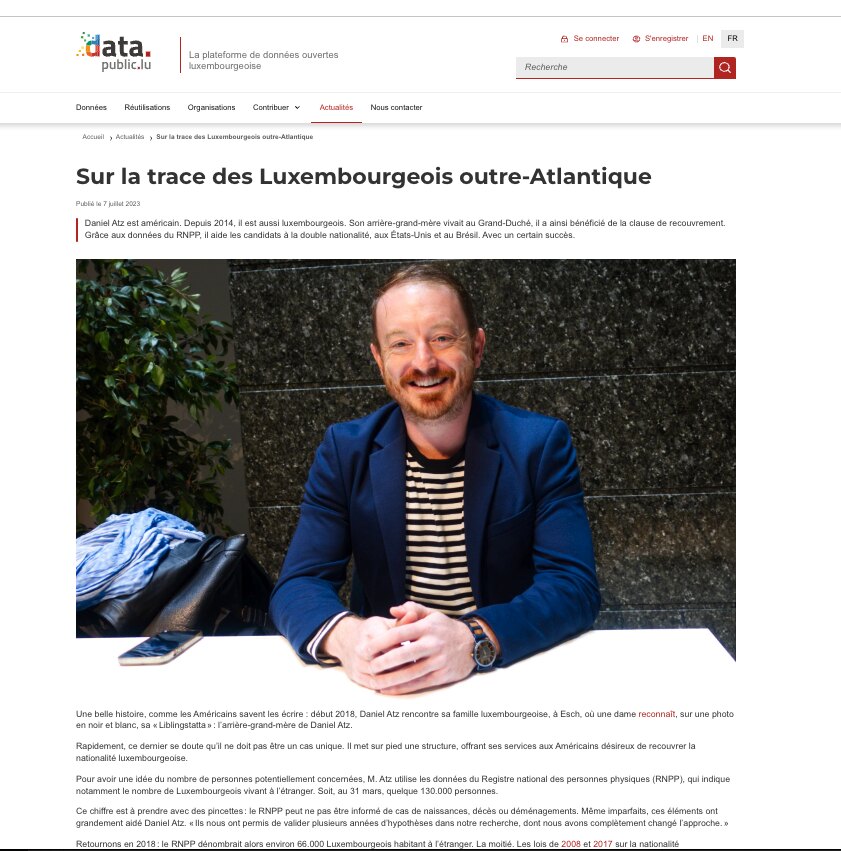
A post published on data.public.lu highlights the growing interest among Americans in tracing their Luxembourg heritage and reclaiming their citizenship. At the center of this movement is LuxCitizenship, a firm that has helped thousands of descendants navigate the nationality restoration process.
The article, titled “Sur la trace des Luxembourgeois outre-Atlantique” (On the trail of Luxembourgers across the Atlantic), explores how digital records and historical migration data are fueling a renewed connection between Luxembourg and its diaspora in North and South America.
Founder Daniel Atz shares how these ancestry-based applications are not only rooted in personal identity, but also driven by a desire for global mobility, connection, and cultural belonging.
👉 Read the original article on data.public.lu (French): Sur la trace des Luxembourgeois outre‑Atlantique →
English Translation
In the footsteps of Luxembourgers overseas
Published on 7 July 2023
Daniel Atz is American. Since 2014, he is also Luxembourgish. His great-grandmother lived in the Grand Duchy, he thus benefited from the recovery clause. Thanks to the data of the RNPP, he helps candidates to dual nationality, in the United States and in Brazil. With a certain success.
A beautiful story, as Americans know how to write them: at the beginning of 2018, Daniel Atz meets his Luxembourgish family, in Esch, where a lady recognizes, on a black and white photo, her “Liblingstatta”: the great-grandmother of Daniel Atz.
Quickly, the latter suspects that he must not be a unique case. He sets up a structure, offering his services to Americans wishing to recover Luxembourgish nationality.
To have an idea of the number of people potentially concerned, Mr. Atz uses the data of the National Register of Natural Persons (RNPP), which indicates notably the number of Luxembourgers living abroad. That is, as of March 31, some 130,000 persons.
This figure must be taken with caution: the RNPP may not be informed of cases of births, deaths or moves. Even imperfect, these elements greatly helped Daniel Atz. “They allowed us to validate several years of hypotheses in our research, of which we have completely changed the approach.”
Let us return to 2018: the RNPP then counted around 66,000 Luxembourgers living abroad. Half. The laws of 2008 and 2017 on Luxembourg nationality have evidently played a major role in this dynamic.
Thus, in 2018, Belgium, France and Germany were competing for the top three of the number of Luxembourgers that these countries hosted. Five years later, Brazil points to third position, relegating Germany off the podium.
The ten main countries where Luxembourgers living abroad reside Number of Luxembourgers by country and by year
Country — In 2018 Belgium — 19,665 France — 18,264 Germany — 14,534 United States of America — 3,147 Brazil — 2,307 Switzerland — 2,101 United Kingdom — 969 Austria — 666 Netherlands — 530 Italy — 517
Country — As of 31/03/2023 France — 31,841 Belgium — 26,666 Brazil — 25,587 Germany — 19,830 United States of America — 13,474 Switzerland — 2,749 United Kingdom — 1,796 Portugal — 1,012 Austria — 963 Spain — 784
Source: RNPP
The Grand Duchy counted on its territory, on January 1, 347,000 Luxembourgers. One understands the impact that the 130,000 Luxembourgers abroad could have during legislative elections. According to Mr. Atz, 70% of Luxembourgers living in the United States and in Brazil are of voting age. In other words: “These Luxembourgers alone represent 10% of voters today registered on the electoral lists in the Grand Duchy, it is an unprecedented fact,” he assures, curious to also look into the Argentine case.
When the American people bring Donald Trump to the White House, at the end of 2016, the website of Canadian immigration becomes inaccessible, because of an abnormally high traffic, reports Mr. Atz. He himself had already undertaken the steps to become Luxembourgish. “All the information to request Luxembourgish nationality was in French, I then created a kit to explain how to proceed.” After a year of scarcity, calls multiply by the hundreds to his company.
In a second phase, Mr. Atz makes use of his knowledge of Portuguese to take an interest in the Brazilian population.
What motivations push these persons to request Luxembourgish nationality? Mr. Atz identifies several factors, including a political one: “The election of Trump was probably a trigger just as, one year later, the fact of signing almost discreetly a tax bill. When, in June 2022, the Supreme Court undermines the right to abortion, we make in two months our turnover of 2019. The peaks of requests that I observed are linked to the most controversial political moments. Likewise, the election of Jair Bolsonaro certainly pushed some Brazilian residents to request Luxembourgish nationality.” The Luxembourgish passport can be seen as a guarantee of stability.
For whom would these neo-Luxembourgers vote?
The first Luxembourgish families arrive in Brazil in 1828. “Luxembourgish immigration to Brazil precedes that to the United States. The first Luxembourger to reach Brazilian soil had a rich lineage: 15,000 descendants,” specifies Mr. Atz. “2,000 of them have requested nationality.”
For whom do or would these neo-Luxembourgers vote? In Brazil, they are very largely settled in the state of Santa Catarina, which voted at 67% for Jair Bolsonaro in the last elections. Impossible, however, to determine to what extent they can be identified with this electorate.
But at a time when Luxembourg political parties travel to Brazil, the question deserves to be asked. “What exactly do the denominations Christian Social People's Party or Socialist Workers' Party mean in the eyes of Brazilians and Americans?” asks Mr. Atz. “I have the feeling that many have of Luxembourg an image that does not necessarily correspond to reality.”
Today, what is the essential data that he is missing? “These two countries are immense. I would like to know the states, even the cities where these neo-Luxembourgers reside. A request in this sense was formulated to the RNPP, in order to obtain postal codes, unfortunately refused.” The RNPP puts forward reasons of quality and reliability of data on the one hand and reasons of protection of personal data on the other, having no knowledge of the degree of granularity of foreign postal codes. Overseas, the fishing for information is hardly more fruitful.
Yet, given the dynamic underway for several years in Brazil, “and this is probably only the beginning”, Mr. Atz would like to understand what is happening there and detect more precisely where these populations live.
Overseas, is there a desire to learn Luxembourgish? To believe the initiator of Luxcitizenship, the answer is affirmative, without hesitation. In certain communities in Brazil, some elders would still speak a dialect close to Luxembourgish. An article published in 2017 in L’Alsace presents a similar story: a Brazilian recites a nursery rhyme in Francic, learned in Rio Grande do Sul. In a survey conducted by Daniel Atz among more than 200 future Brazilian dual nationals and more than 1000 American dual nationals, more than 80% of participants say they are desirous to learn Luxembourgish.