
Press coverage
Daniel Atz Discovers Luxembourgish Roots in Argentina
Read the original article at Wort/Telecran →
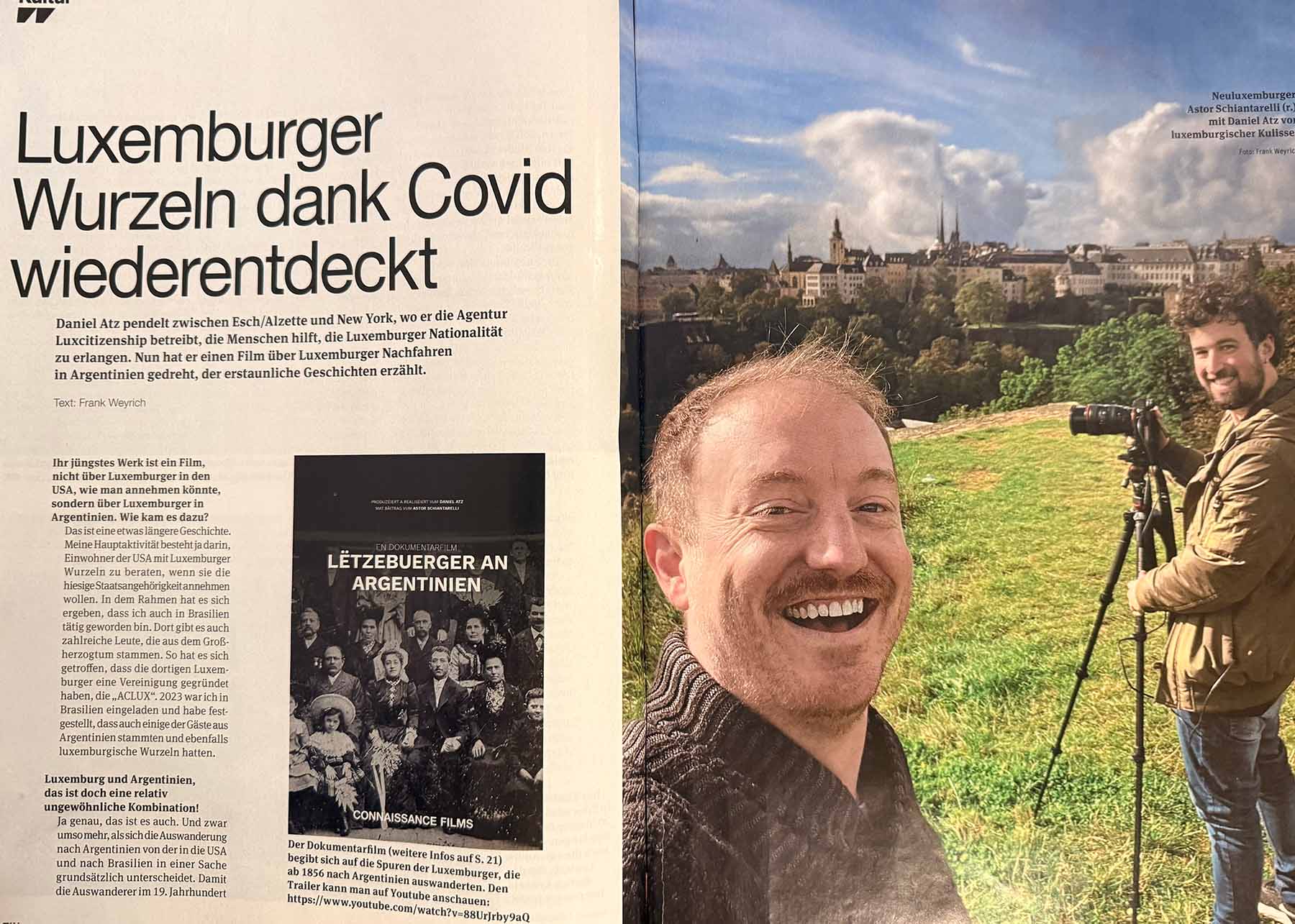
Original Article Published Date November 13th, 2025 (Print)/26 (Online), Journalist Frank Weyrich
An interview was published with Daniel Atz in Telecran, a wide distribution magazine in Luxembourg, as well as a republished version was released on the website of Luxemburger Wort.
In the interview, Daniel answers some background questions about what led to the creation of the film Luxembourgers in Argentina. From this original article, Telecran went on to do another interview with the project’s Co-Director Astor Schiantarelli.
English Translation
Culture
Luxembourg roots rediscovered thanks to Covid
Daniel Atz commutes between Esch/Alzette and New York, where he runs the agency Luxcitizenship, helping people obtain Luxembourg nationality. During the pandemic he made a film about Luxembourgish descendants in Argentina that tells astonishing stories.
His latest work is not a film about Luxembourgers in the USA, as one might assume, but about Luxembourgers in Argentina. How did that come about? Director and main protagonist Daniel Atz has Luxembourgish roots himself. His great‑grandfather Théo Binsfeld emigrated in 1904 at the age of 15. Today, Atz’s agency supports around a thousand people a year in applying for Luxembourg citizenship. Many are descendants of emigrants from the 19th and early 20th centuries.
Luxembourg and Argentina, that does not sound like an obvious pairing at first. Yet around 1850, some 180 Luxembourgish families emigrated to Argentina. They left their homeland because of hunger and poverty, and because many had no land of their own. In Argentina they often worked as tenant farmers.
To obtain the right to live in Argentina, they had to commit to speaking only Spanish and abandoning their ancestral language. This quickly led to the Luxembourgish language disappearing. The process unfolded within just one generation. Some typical family names survived, but the connection to the original culture was not passed down from one generation to the next. The conscious desire to stay connected with the past is therefore more often found among their descendants than among the immigrants themselves.
The documentary film “Lëtzebuerger an Argentinien” (Luxembourgers in Argentina) follows these descendants on their search for identity. It shows how they slowly rediscover their Luxembourgish roots and how this can fundamentally change their view of themselves.
“It is the younger generation that has rediscovered this fact (of having roots in Luxembourg) for themselves.”
Film producer Daniel Atz
How did it come about that so many people in Argentina suddenly began to trace the Luxembourgers there?
At first it happened through contacts I had already developed in Argentina. Four people who appear in the film were already clients of mine. All four came to me on their own and told me they had Luxembourgish ancestors. Through them and their families I got to know a large number of people. Because of their Luxembourgish origin, they had been asking themselves questions—sometimes consciously, sometimes unconsciously.
So it is often people in Argentina who have become aware of their Luxembourgish roots—and this happened during Covid.
What does Covid have to do with people rediscovering their Luxembourgish roots?
The pandemic affected people’s inner lives. It was a time when we were very much alone with our thoughts. There were bans, isolation and depression. Questions of national origin had rarely arisen so strongly before. During the pandemic they suddenly became more pressing for many people. They asked themselves: Where do I come from? Where are my roots?
Did this lead to a kind of rediscovery for these people?
Yes, something like that. One case especially moved me. Imagine a 50‑year‑old monolingual woman who speaks only Spanish talking to her 94‑year‑old grandmother, who once spoke all the languages of the region. The older woman starts off in Spanish, gets stuck, and suddenly switches into Luxembourgish—which her granddaughter no longer understands. It is in moments like these that you feel how important it is to hear the Luxembourgers’ own voices.
In the film we also looked for someone in Argentina who could help us shoot. After his online application I noticed his strong interest and we soon discovered that he himself had Luxembourgish roots. After filming, with the help of the Ministry of Justice, we established that he actually holds Luxembourg nationality, even though he had been unaware of his family history and of this status. Astor Schiantarelli became, in January of last year, the first person in Argentina to receive Luxembourg nationality under the current legislation.
So there is interest in Luxembourg in Argentina?
Yes, that was clear to me, even if it is still not massively visible. There are two reasons Luxembourg hardly stands out. First, the country is very small. Second, Luxembourgers in Argentina assimilated extremely quickly. If you ask people in Argentina today whether they have roots in Luxembourg, it is often difficult for them to answer.
During the Second World War many Luxembourgers fled Nazi‑occupied Europe to South America. Most ended up in Brazil and Mexico, some also in Argentina, but these are isolated cases compared with earlier waves of emigration.
What is the situation like at the moment for people in the USA who have Luxembourgish roots and want nationality?
In Luxembourg itself, the digitalization of government services is very advanced. That makes procedures relatively straightforward there. Transferring that one‑to‑one to a country like Argentina is difficult, because many people lack stable internet access or live and work under very different conditions. In the USA, such rules would affect a much larger population again. I expect high, but very specific numbers when it comes to nationality applications from abroad.
Luxembourg is not the only country that allows dual citizenship in such cases. A whole range of European countries have similar regulations.
For me personally, what began almost as a playful idea has become something very serious. As someone who is also involved in LGBT issues, I can say that this film has even helped me shed some of my own nervousness about questions of identity.
The film
The documentary “Lëtzebuerger an Argentinien” has already been screened at several festivals, including in Aachen. In it, Daniel Atz tells the story of people of Luxembourgish descent in Argentina and how they are reclaiming a part of their heritage.
Editor’s note: this article states Daniel’s great-grandfather Théo Binsfeld emigrated in 1904; in fact his great-grandmother Marguerite Kruchten of Esch-sur-Alzette emigrated after WWI.