
Press coverage
The Fifth Constituency
Read the original article at Lëtzebuerger Land →
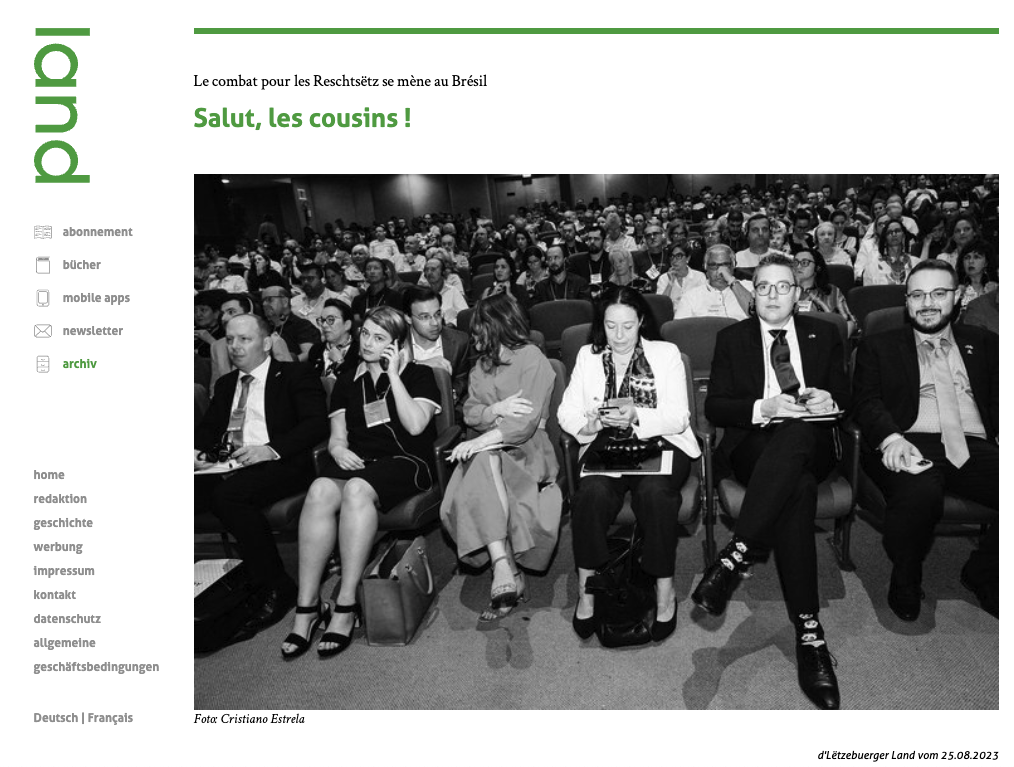
As more Luxembourgers abroad reclaim their nationality and engage in civic life, the idea of a “fifth constituency” — made up of citizens living outside the country — has begun to take shape. A recent article published by d’Lëtzebuerger Landexplores this evolving dynamic and features insights from LuxCitizenship founder Daniel Atz.
The article, titled “The Fifth Constituency”, looks at how thousands of dual nationals, especially in the United States and Brazil, are gaining the right to vote and participate in Luxembourg’s democratic process. Daniel offers context on how this change came about, who these new voters are, and how reconnecting with Luxembourg through citizenship is reshaping their personal and political identities.
The rise of this global voter base has broad implications — not just for elections, but for how Luxembourg sees its diaspora in the 21st century.
👉 Read the original article on Land.lu (German): DEU: Hauptstadt‑Region will stärker wachsen – Chancen und Herausforderungen →
English Translation
What will be the electoral weight of the Luxembourgish diaspora in the next legislative elections
The Fifth Constituency
Yuriko Backes last August at the “Luxembourg Fest” in Wisconsin
Photo: Twitter
d’Lëtzebuerger Land of 03.03.2023
In 2006, the Minister of Justice, Luc Frieden (CSV), slipped a singular passage into his bill on nationality. Article 29 pushed the logic of the right of blood to the absurd: it allowed the descendants of a “Luxembourgish ancestor” to recover nationality, on condition of identifying in their family tree a direct ancestor (often distant by four, even five generations) who had held Luxembourgish nationality in 1900. In October 2008, at the moment of the vote, no deputy criticized this provision which thus passed almost unnoticed. While the Grand Duchy continues to refuse the right to vote to half of the real country, it granted it to a community of Luxembourgers more or less imaginary. These latter had ten years to introduce their request. (Because of the pandemic, the deadline will end up being postponed to December 2022, in order to allow them to complete the procedure by presenting themselves before the civil registrar.) The liberal government will qualify in 2021 the recovery clause as “derogatory and temporary to common law”. It experienced exponential growth, the number of files passing from 22 in 2019 to 4,273 in 2022. In the end, the number of “neo-Luxembourgers” could exceed 47,000. In Brazil alone, there are now some 15,500 potential voters, that is more than the population of Hesperange. An enormous reservoir of votes which remains very little mobilized and which arouses covetousness.
At the beginning of February, the parliamentary groups received an email written in imperfect French and signed by the Association of Luxembourgish Citizens of Brazil (ACLux): “ACLux comes to formalize the invitation to participate in our event which has as objective to strengthen the links and to dialogue with the local community of neo-Luxembourgers concerning the electoral process in the Grand Duchy”. The parties are invited to go to Florianópolis, capital of the state of Santa Catarina, to meet their potential voters there. For the large meeting, fixed for Saturday, April 1, ACLux and the local government have reserved the Teatro Governador which counts 750 seats. Each party present should have one hour at its disposal to present its program. (Which could explain that the event begins at 8:30 in the morning.) Until now, only the Pirates and Déi Lénk have accepted the invitation. The other parties hesitate and look at each other like dogs of earthenware. If one of the large parties decides to make the transatlantic trip, the others will follow. Contacted by the Land, the CSV, the LSAP, the DP, the Greens and the ADR say that they have not yet taken a decision; they would still be discussing it internally. All explain that the travel costs will not be covered by the Chamber, but by the political parties; except Déi Lénk, which estimates that the costs will be covered by the state of Santa Catarina.
From expatriates of Vienna or Paris to the “atypical cross-border workers” of Nittel or Villerupt, passing by the neo-Luxembourgers of Santa Catarina and of Wisconsin, Luxembourgers abroad constitute an extremely heterogeneous category. The National Register of Natural Persons counts 31,500 Luxembourgers in France, 26,500 in Belgium, 20,000 in Brazil, 19,600 in Germany and 12,300 in the United States. Over the last decade, the multiplication factor was two for Belgium, five for France and ten for Brazil and the United States. But the figures of this register are notoriously little reliable. The estimates of Statec prove thus clearly more cautious. The Ministry of State recalls, for its part, that it is “not possible to know exactly the number of Luxembourgers living abroad”, since changes of residence abroad do not have to be obligatorily declared to the Grand Duchy; no more than births and deaths.
“There are more eligible voters in Brazil and in the US than there are in Luxembourg City”, enthuses Daniel Atz, the founder of Luxcitizenship. “There is no precedent for it on the planet. There could be effects…” The American had recovered Luxembourgish nationality in 2014 and was one of the first to identify a business model in the “recovery 1900”. He left his job at the Belgian-American Chamber of Commerce to offer administrative and genealogical services to American, Brazilian and Argentine candidates. The neo-Luxembourgers are not automatically registered. The process would “not be so complicated”, says Atz, even if the postal logistics would have posed problem during the last election. The electoral law does not provide the possibility to vote at embassies. Luxembourgers non-resident must therefore go through voting by correspondence, by registering in the commune of “their last domicile, failing that the commune of birth, failing that the City of Luxembourg.” The “neo-Luxembourgers” therefore vote automatically in the Centre constituency. Their ballots land at the Cercle Municipal, the office which centralizes votes by correspondence in the capital. In 2018, the rush had not taken place. In total, 5,489 ballots by correspondence had been sent from abroad, of which only 1,078 were addressed to the City of Luxembourg. The neo-Luxembourgers participating in the election therefore were finally counted in hundreds rather than in thousands.
The deputy Sven Clement (Pirates) has already begun to clear the ground. In May last year, he visited the Brazilian neo-Luxembourgers, making the tour of the town halls of Santa Catarina. A form of political opportunism to develop a personal niche? Clement dodges: “When I am there, I am not going to tell people not to vote for me”. This transatlantic trip would have allowed him to establish “many contacts” and to “know many people”, estimates Roberta Züge, one of the officials of ACLux, who settled in Luxembourg in 2020. The meeting of April 1, she says, should give to other politicians the occasion to make themselves known. The state of Santa Catarina, which concentrates a large part of the new Luxembourgers, is not exactly a progressive region: 69.3 percent of inhabitants voted Bolsonaro in the last elections. Roberta Züge does not think that one can draw from it predictions relating to the Luxembourg legislative elections: “People will not vote for a political party, but for persons”. And to add: “It will therefore depend on who will speak in front of the people there”. Reached in Brazil, where he is currently filming a documentary on the neo-Luxembourgers, Daniel Atz shares this analysis: “What everyone has told me so far in Brazil is that they will be voting for those they meet and have in front of them”. In 2017, the publicist Pierre Lorang already wondered in Forum what the Luxembourg political landscape could inspire to the neo-Luxembourgers of the American Midwest: “What does ‘christian-social people’s party’ mean for an American? What does he associate with ‘socialist workers’ party?”
Züge considers that, this time, a relatively high number of Brazilians would show interest in participating in the legislative elections, especially among those who have projects to settle in the Grand Duchy. Sven Clement estimates that the interest of neo-Luxembourgers for the legislative elections would be comparable to that of foreign residents for municipal elections. He evokes the possibility of creating a “consultative chamber to give them a voice in the affairs which concern them”. According to Züge, the subjects which would interest descendants in Brazil would be very practical: recognition of diplomas, labor market, access to language courses. ACLux displays among its objectives “the diffusion of ethical, political and cultural values which govern Luxembourg society”. It promotes the mastery of the “official languages”, distributes didactic material on institutions and society and organizes “courses of Luxembourg gastronomy”. But the association also intends to weigh politically. It thus intends to “allow the registration and the effective participation of Luxembourgers residing in Brazil in the electoral processes of Luxembourg and of the European Union”.
Last August, the liberal Minister of Finance went to the “Luxembourg Fest”, organized annually at Belgium, a small town in Wisconsin. (At the last presidential election, Donald Trump obtained 70 percent at Belgium Village.) She took advantage of the occasion to feed her social media accounts: “Fantastic to witness Luxembourg pride & heritage in this community”. Under the influence of the director of Sites and Monuments, Georges Calteux, the Ministry of Culture had generously co-financed the “Leaves and Roots Museum”, implanted in the middle of a residential development project baptized “New Luxembourg”. Yuriko Backes encountered there Cardinal Hollerich, a crowd of diplomats… and Sven Clement who paraded through the streets with his parliamentary scarf. The minister and the deputy had gone to the folkloric festivities in a private capacity, making there a stopover during a family trip.
The Pirates are the only ones to have systematically integrated the neo-Luxembourgers into their electoral strategy. “On the other side of the Atlantic, in the south of Brazil, the name of Sven Clement is now well known”, rejoiced Le Quotidien in June 2021. Three months earlier, the deputy had deposited his first bill. This one aimed to extend until 2030 the recovery provision. In his statement of reasons, Clement refers to the “cosmopolitan and intercultural spirit”, but at moments, the argument takes on völkisch accents, as when he evokes “the link which unites [the neo-Luxembourgers] with the land of their ancestors, their land”. The distant descendants would be “hereditary of Luxembourgish culture” and could propagate throughout the world “Luxembourgish values and traditions”.
In December 2021, the bill of Sven Clement ended up being rejected by 54 votes. Gilles Roth estimated that “this is enough now with this transitional phase of recovery”. Carole Hartmann (DP) recalled that the path towards nationality must remain naturalization. Charles Margue (Déi Gréng) found that the situation “begins to be a bit exotic”. Nathalie Oberweis (Déi Lénk) castigated an “anachronistic” rule and pleaded for the principle of the right of soil. Only the ADR followed the logic of the Pirates, seeing in it a consistent application of “ius sanguinis”, to immediately warn against possible “abuses”. The right-wing populists ended up voting the proposal of the pirate populists. The Minister of Justice, Sam Tanson (Déi Gréng), did not hide her exasperation: “I remain of the opinion that we would do better to concern ourselves with the integration and naturalization of those who effectively live in the country and who engage themselves in society”.
The invitation for Florianópolis raises a question of principle: must one salute the fact that tens of thousands of persons who have never lived in the Grand Duchy can elect its representatives? The responses of the parties remain conventional. The CSV and the LSAP see in recovery “a success” and recall that all Luxembourgers have “the same rights and duties”. Déi Gréng explains not having been “requester of this measure”, while Déi Lénk reiterates its opposition to the principle of the right of blood and to the “logic of heredity”. However, the situation being what it is, the State should “assume its responsibilities” vis-à-vis these new citizens, writes Déi Lénk, while Déi Gréng recalls that neo-Luxembourgers are “citizens, like others”. The response of the ADR is the most expeditious. It holds in four words: “We stand positive towards it”. The question nevertheless places the party in front of its contradictions. For while displaying its linguistic purism, the ADR pleads for a recovery procedure which does not take into account at all the mastery of Luxembourgish.
Recovery could make visible the great forgotten of Luxembourg politics, namely the cross-border workers. Many Lorrains and Walloons discovered an ancestor in Luxembourg and recovered nationality. Every five years, political parties pretend to take interest in this electorate. As early as 2013, the DP, the CSV and Déi Gréng had played a brief campaign in the province of Luxembourg. Upstream of the legislative elections, most heads of list made a passage in Arlon. During a conference, Luc Frieden thus explained to the Belgian press his merits in the development of the financial center. “Most are concerned by the same problems, because they are cross-border workers. (…) We were questioned on mobility problems”, will later recount the CSV politician Maurice Bauer to Le Quotidien. One also learned that Camille Gira and Christianne Wickler planned to distribute leaflets at the Arlon station (from 7 a.m.), while Henri Kox prepared a meeting across the Moselle. As for Xavier Bettel, he organized an electoral evening in Arlon, the city of birth of his future husband, before about fifty persons. A few months earlier, during a consultation debate at the Chamber, Bettel had evoked the interest aroused in Belgium by the “recovery 1900”: “A very many in Belgium, when there was the crisis in the government, said: ‘We do not know how it will go, therefore we request a Luxembourg passport’.”
For the governing parties, the question of Luxembourgish cross-border workers, also called “atypical”, has a symbolic charge otherwise more violent. There do not exist reliable statistics on their number. Statec has a view on persons who leave the territory, but not on their new places of residence. Liser had published a study based on data of 2007, but this one has not been updated for twelve years. Remain the figures of the IGSS, according to which there would be 13,500 Luxembourgers residing abroad while continuing to work in Luxembourg. But by including persons factitiously registered in Luxembourg (notably so that their children can continue to attend school there) as well as retirees, this figure should easily exceed the threshold of 20,000.
In an article published in September 2021 in Forum, the former advisor for Foreign Affairs, Victor Weitzel, had proposed to create professional consulates in the regional capitals Mainz, Saarbrücken, Namur and Metz. Such a diplomatic presence should be ensured by “top officials”, charged notably with taking care of Luxembourgish nationals. The Minister of the Greater Region, Corinne Cahen (DP), did not see the usefulness; honorary consuls would suffice, she said in January 2021 to the Land. As early as 2008, Ben Fayot had pleaded for a strengthening of the political representation of Luxembourgers who left very close by. The socialist deputy reflected on the possibility of installing “three or four polling stations in foreign peripheral regions” and cited the example of senators and deputies for French living abroad. That remains very little thematized, but settling on the other side of the border seriously harms political rights. The passive right to vote being linked to residence, Luxembourgish cross-border workers cannot present themselves as candidates in legislative elections.