
Press coverage
Transatlantic election
Read the original article at Lëtzebuerger Land →
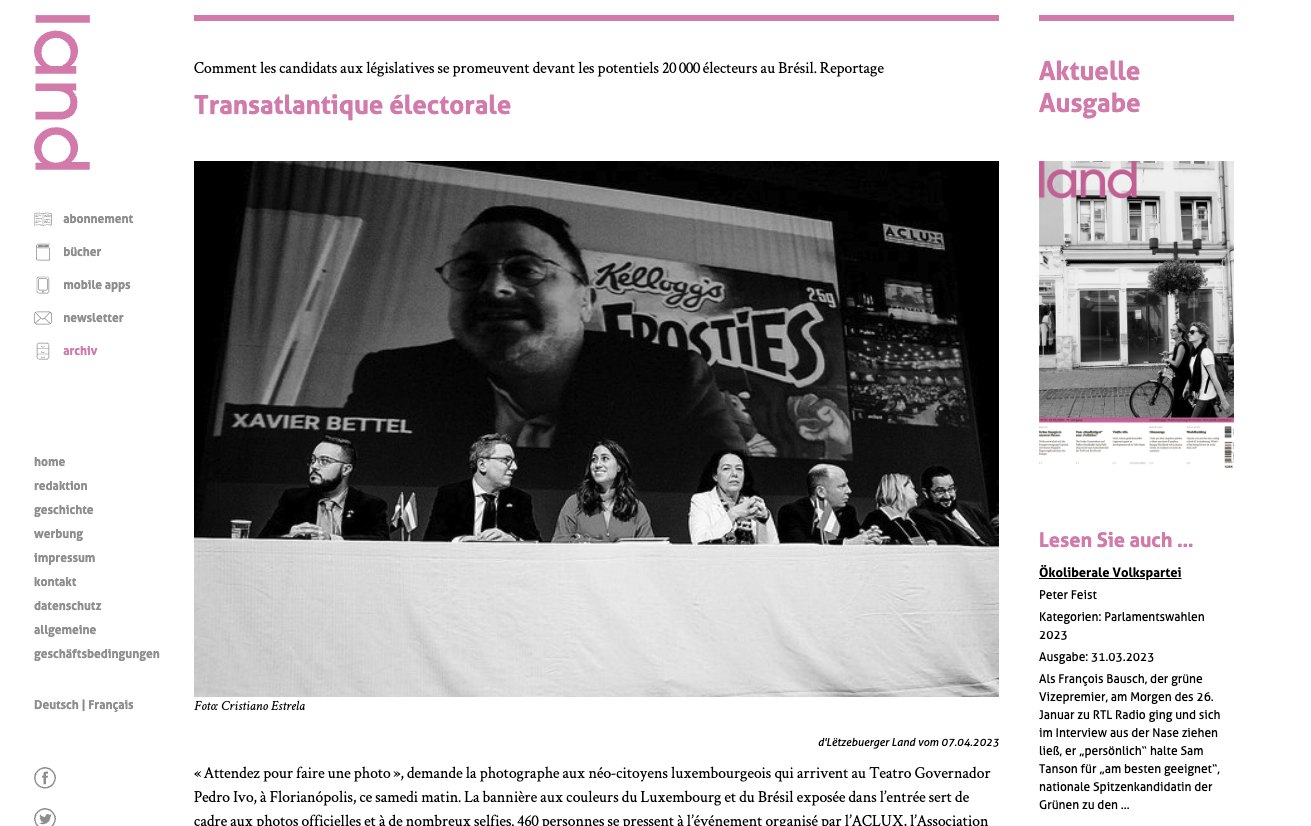
As Luxembourg’s population of dual citizens continues to grow abroad, especially in the Americas, its elections are increasingly shaped by voices beyond its borders. In an article published by d’Lëtzebuerger Land, this evolving reality is explored through the lens of global civic participation — with insights from LuxCitizenship founder Daniel Atz.
The article, titled “Transatlantic Electorate”, looks at how thousands of Luxembourgish descendants in the United States and Brazil have reconnected with their ancestral homeland through the 2008 nationality law. With many of these individuals now eligible to vote, the country’s electorate is increasingly global — and Daniel’s insights help explain both the logistics and motivations behind this shift.
LuxCitizenship’s efforts have empowered a new generation of Luxembourgish citizens abroad to take part in civic life, giving a voice to the transatlantic diaspora.
👉 Read the original article on DanielAtz.com: Transatlantic Electorate →
English Translation
Transatlantic electoral
The candidates on stage Saturday in Florianópolis
Photo: Cristiano Estrela
d’Lëtzebuerger Land of 07.04.2023
“Wait to take a photo,” asks the photographer to the neo-Luxembourgish citizens who arrive at the Teatro Governador Pedro Ivo, in Florianópolis, this Saturday morning. The banner in the colors of Luxembourg and Brazil displayed in the entrance serves as a frame for official photos and for numerous selfies. 460 persons crowd at the event organized by ACLUX, the Association of Luxembourgish Citizens in Brazil, in the capital of the state of Santa Catarina, where lives a large part of the Brazilian-Luxembourgers. The meeting consists in presenting the parties in the running for the legislative elections and in explaining the Luxembourg electoral process. Many know that they can vote, but many also ignore that two elections are held this year in the Grand Duchy.
Volnei Nicodem, 41 years old, administrative manager, obtained his Luxembourgish nationality in 2019. “The process was very fast. It took more or less one year,” he recounts. His European roots go back six generations. One of the remnants of this heritage is the German language, which he learned at home with his father and which was transmitted from generation to generation. “It is a dialect that resembles Luxembourgish,” he adds. He did not know that there were elections this year in the Grand Duchy, but he now wishes to exercise his right to vote. Volnei Nicodem caresses the distant dream of using, one day, his European passport to live in Switzerland. A dream that his brother, Frank Nicodem, 37 years old, manager of a school, will realize this year. In May, he embarks with his wife and his two children for Luxembourg with one-way tickets. “I speak German, a bit of English and I learn French. In the future, I want to work in the banking sector,” he testifies.
The Nicodem family is one of the 566 members of ACLUX, an association created in 2019 when the number of Brazilian requests for recovery of Luxembourgish citizenship exploded. The association was created with the intention of providing new citizens with information about their rights and their duties, but also about the linguistic and cultural aspects of the Grand Duchy. To become a member, one must pay an annual fee of one hundred Brazilian reais (around sixteen euros). Equipped with its own statute, ACLUX elects every two years the members of the board of directors. In general, it is composed of citizens having a well-established life in Brazil, such as lawyers, doctors, civil servants, politicians, retirees. They see in their Luxembourgish passport the pride of having rediscovered the history of their family. Giseli Junckes, for example, came to the event with her nails painted in the colors of the Luxembourg flag. But she does not have the intention of living in Europe: “I am a civil servant, I have no reason to leave Brazil, but I think that this could be an opportunity for my daughter in the future,” she reflects.
Organized and voluntary, ACLUX has met some successes during its brief history. For example, the authorization by the Luxembourg government to translate the first module of the course “Living Together” into Brazilian Portuguese and the signing of a cooperation agreement with the same association in Argentina. However, nothing is comparable to the exploit of last Saturday: convincing Luxembourg politicians and authorities – in full period of municipal elections – to take three airplanes for a trip of around 24 hours towards the south of Brazil. A saying often used by Brazilians to keep hope says that “faith moves mountains.” Apparently votes also.
At thousands of kilometers from the Gëlle Fra, the largest country of Latin America counts more Luxembourgish citizens than neighboring Germany. At the end of 2022, 19,939 Luxembourgish citizens lived in Brazil, according to the National Register of Natural Persons of Luxembourg. These figures are presented by Daniel Atz, an American-Luxembourger who promotes the recovery of citizenship for Brazilians and Americans. He is one of the speakers of the event of this Saturday, charged with explaining to the public the functioning of the Luxembourg electoral process. Daniel Atz shows an image of the ballot to the public, accustomed to one hundred percent computerized elections since 2000. He explains the two voting options (by list or by candidate) and recalls the deadlines. Brazilian-Luxembourgers are registered in the center constituency and will therefore have the right to 21 votes. The registration period to request the ballot ends on August 29. Sending it to Brazil requires around ten days. For the envelopes to return to Luxembourg before 5 p.m. on October 6, Daniel advises voters to send them by DHL in the last days of September. According to the DHL website, sending an envelope from Florianópolis to Luxembourg City can cost around 350 R$ (around 64 euros). Besides the cost, a copy of the passport can be required to vote and certain persons having obtained Luxembourgish nationality are still waiting for their passport to be delivered. For Daniel Atz, Luxembourg law is not clear on this subject and it is a question that politicians must resolve.
It is in any case difficult to know if these citizens with dual nationality will really vote.
Barbara Grein, landscape gardener of 38 years, discovered the elections thanks to ACLUX. She woke up at three o’clock in the morning and came by charter bus from a countryside city of Paraná, at 315 km from Florianópolis, to learn more about Luxembourg. She affirms however: “I will not vote. That has no meaning for me. I do not live there.” Flávio Belli, 48 years old, does not agree: “Brazilians who live abroad can vote. As citizens, it is a right that we have,” he declares.
Even in the uncertainty, Liz Braz (LSAP), Djuna Bernard (Déi Gréng), Isabel Wiseler (CSV), Frédéric Becker (ADR), Sven Clement and Mathis Godefroid (Piraten) did not spit on the chance to obtain these additional votes. Déi Lénk declined the invitation because they judged the trip too expensive. They certainly lost the game. The party of the left is not cited once during the eight hours that the event lasted. The Democratic Party, for its part, has a bit more luck. The DP declined the invitation for environmental reasons, but it managed to obtain a few minutes of visibility at the opening of the event. Thus appears on the giant screen the Prime Minister, Xavier Bettel. Apologizing for not being present and to give coherence to the justification of his absence, he puts the emphasis on the climate crisis. The liberal also speaks of the importance of continuing to support Ukraine. He jokes about the fact that he has never gone to Brazil: when he was preparing to come at the invitation of the president Dilma Rousseff, she was removed from office. Smiling, Mr. Bettel congratulates the neo-Luxembourgers for having recovered their citizenship and says himself proud that, thanks to them, Luxembourgers are now larger.
The hour of the attack
The order of appearance of the parties was defined by drawing of lots. All present slides translated into Portuguese. That facilitates the understanding of the audience which benefits from simultaneous translation. Except for Isabel Wiseler-Lima. The elected CSV speaks in Portuguese with a Lusophone accent. The first to speak was Frédéric Becker. The representative of the ADR shows himself respectful, but does not seem very motivated. (He moreover does not use all the time that he has.) He explains that his party is conservative, but that it has different currents. He says himself impressed by the hospitality and tries to identify himself with the public by mentioning the fact that he also obtained Luxembourgish nationality recently, in 2017. He underlines his career in the German army and speaks of values, such as the promotion of family and religion.
The young Liz Braz (LSAP) is the second to present herself. During an event where the Brazilian vocabulary of foreigners limits itself to bom dia and obrigado, Liz Braz surprises everyone by pronouncing her speech in Portuguese. One of the organizers of the event remarks that Liz Braz refused to dine the evening before to dedicate herself to her presentation. That is worth it! She wins the sympathy of the public and is very applauded. On her Instagram profile at the beginning of her stay, Liz Braz showed little enthusiasm. During the presentation, Liz Braz explains that the meetings that she had the day before allowed her to understand this new relationship between the two countries and that she is eager to return to Luxembourg and to sensitize her party colleagues to the pride of Luxembourgish citizenship in Brazil. She recounts moreover who is her father (Félix) and the history of her family of Portuguese immigrants who went to try their luck in the Grand Duchy. Her party colleague the Minister of Foreign Affairs, Jean Asselborn, who is at the same moment in Chile, sent a video: “We are grateful to Brazil for having opened its doors and we will return the favor, even if it is more than a century and a half later,” he commits. Liz Braz underlines that her party is well established, that it is partner of various coalitions and that it invests in five pillars: housing, the economy and climate, health, education, work and social affairs. At the end of the presentation, when Liz Braz leaves the stage, one of the participants warns her politely: “Maybe you will not leave with many votes from here,” in reference to the socialist ideology of the party. Santa Catarina is one of the states where the elected president Lula, of the Workers’ Party, received the least votes. Nearly 70 percent of the voters of Santa Catarina voted for Bolsonaro.
The third candidate to line up, Djuna Bernard (Dei Gréng) will be candidate in the center and will be able to be elected directly by the neo-Luxembourgers who met her here in person. Djuna Bernard already came to Florianópolis as a scout, but she did not imagine that she would return there about ten years later. She thus speaks of the history of her party and of the pioneering spirit that animates it to draw attention to the question of climate. When she declares wanting to reform the Luxembourg tax system, which favors inequalities, she is applauded. She finishes by saying herself surprised that the auditorium is full and that most of the time, she does not see the same interest from Luxembourgers. Isabel Wiseler-Lima goes on stage in the afternoon to present the CSV, the largest opposition party in Parliament. In Portuguese, she explains that the history of the party is closely linked to that of the country. In the past, it would have been more conservative and linked to the Church, and little by little, the CSV would have become more social. Isabel Wiseler-Lima recalls the diversity that exists in Luxembourg and that it is not always easy to live together. She specifies the will of the party to return to power in October. Her husband, Claude Wiseler, who will be candidate in the center, makes a brief appearance online. He shares that he is impressed to see the room full and that he regrets not having come.
While the stomachs already rumble, the Pirates, Sven Clement and Mathis Godefroid, both candidates in the center, enter on stage. Sven Clement avoids the hunger and the sleepiness of the public by speaking of what they wanted to hear: less ideology and more interesting proposals for the new Luxembourgers, such as the recognition of diplomas, free Luxembourgish courses, the creation of an itinerant consulate for the production of passports, the facilitation of remote voting, among others. The ingenuity does not come only from eloquence, but also from the proximity constructed with Santa Catarina since 2021. It is the third visit of Sven Clement to Santa Catarina. He thus recalls that there do not exist Luxembourgers of second zone and that his party fought to extend the deadline of reintegration in nationality during the Covid-19 pandemic.
Adopted by Parliament in 2008, no one could have imagined the international popularity of the nationality law. At the time, the Minister of Justice, Luc Frieden (CSV), had written into the bill the possibility for descendants of a Luxembourgish ancestor to recover nationality on condition of being able to prove the existence of a direct Luxembourgish ancestor in 1900. The filing deadline was to expire on December 31, 2018, but it has since been extended several times and remains open until December 31, 2025.
A long day
Visibly tired, after lunch and a cultural presentation, the representatives of the parties go back on stage for a round table with the members of the board of ACLUX. It is the moment to speak of the needs and wishes of the new Luxembourgish citizens. Sven Clement does not miss the occasion to express himself, while Frédéric Becker seems to listen to music in his translation headset, so much he is distracted. The other candidates show a certain lack of mastery on subjects such as recognition of diplomas, economic negotiations, cultural exchanges and integration. Concerning neo-Luxembourger doctors who try to validate their diploma while the Grand Duchy lacks professionals, Liz Braz promises to carry the message to the Minister of Health, Paulette Lenert, of the same party. Isabel Wiseler remarks that insertion into the labor market, whatever the domain, encounters the language. “It is not possible for a person who works with the public to speak only one language,” she says. Concerning bilateral affairs, the candidates recall that Luxembourg is part of the European Union and that it is not something that can be done from one day to the next. Sven Clement responds that business relations already exist and that only customs and sanitary barriers must be respected.
One of the principal complaints formulated by ACLUX is that Brazilian-Luxembourgers arrive in the country as citizens, but that they are also immigrants, and that the programs of qualification and integration of immigrants do not apply to them. Even without concrete response, the neo-Luxembourgers come out winners from this meeting. “We have a very long road ahead of us. We will not necessarily vote this year. It is very new for us and for them. Our principal objective is to create this link, this connection with Luxembourg authorities and we have succeeded in it. It was very positive. Many doors will open,” confides the president of ACLUX, Valberto May, in an interview. He also declares that ACLUX cannot pronounce itself in favor of a party. “If a member of the board of directors wishes to support a candidate or a party, he must withdraw temporarily from the entity,” he adds. Seven months before the elections, the challenge consists in maintaining the warm relationship with Luxembourg politicians and finding new motivated voters. At the end of the event, at 5 p.m., the room is no longer as full. Numerous photos taken at the arrival remain hung on the wall.
The day after the conference, the Luxembourg elected officials were invited to plant a tree in a park of Florianópolis. It was offered by ACLUX. It is a species originating from the mountainous regions of the canton of Santa Catarina. The question arises of knowing if the tree will survive in these conditions. Questioned by the Land, two botanists inform that its chances of survival will increase if it benefits from special care. Perhaps an allegory.