Daniel Atz builds research institutions around a gap most people don’t know exists: no one
systematically counts the people who move between countries. The work below spans a 99-country
publication, investment-migration data built from primary government records, and the diaspora
research where the practice began.
American Emigration Revue
No federal agency counts the Americans who leave; there has been no federal census of Americans
abroad since 1976. The American Emigration Revue,
which Daniel founded and edits, was built on the alternative: if the American state won’t count
its emigrants, ask the receiving states. AER is an independent research publication — original
reporting, a weekly brief, and a continuously updated dataset spanning 99 countries, built by a
network of country researchers working in 21 languages, with a
Data Transparency Index scoring how
openly each country reports its American population. All of it lives on the Revue’s own site —
americanemigration.com.
Investment migration, from inside the process
Using Brazil’s Diário Oficial da União, MigranteWeb filings and the CNPJ corporate registry,
Daniel tracks the real-world uptake of Brazil’s investor residency pathways — research grounded
in a process he completed himself as a startup investor. His analysis of 2025 found that
512 investors chose Brazil that year, and almost none used the most favorable pathway. The dataset behind it continues at
StartBrazil.
Papers
“The Exodus Mindset” (March 2025)
“EU Citizenship as Refuge” (October 2025)
Where the practice began: the Luxembourg diaspora
Daniel’s first research subject was the movement he was part of. Drawing on Luxembourg’s open
government data and LuxCitizenship’s anonymized case files, The LuxCitizenship Study
mapped the country’s new dual citizens across the Americas over four editions through 2024 —
work
profiled by the Luxembourg government’s open-data portal
and held in the catalogue of the
Centre de Documentation sur les Migrations Humaines
in Dudelange.
Why are Argentines applying for Luxembourgish citizenship? This is the first survey to measure how these new dual citizens see Luxembourg and their future in Europe. Background In April and July of 2023, we ran an open survey of Argentine-Luxembourgish dual citizens through ancestry. 124 dual citizens participated representing a wide range of ages and demographics. The
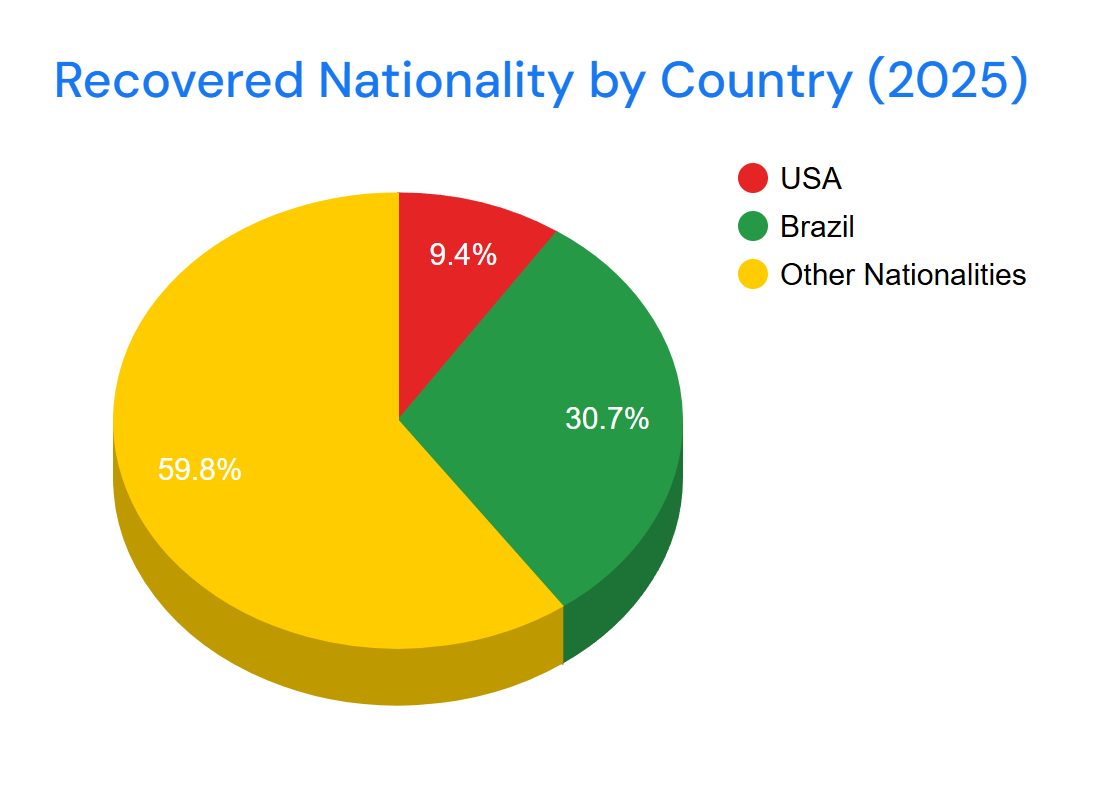
We leverage Luxembourg government data to conduct in-depth analyses of the growth in the Luxembourg Dual National population and migration trends in Luxembourg. This page is updated on an ongoing basis. To learn what pathways are open for Luxembourg dual citizenship in 2026, please click here. Citizenship Recovery – Article 89 According to the Ministry of Justice,
Source: Diário Oficial da União (DOU) · MigranteWeb · CNPJ corporate registry Today, global risk is less about any single event and more about accumulation. Supply chains, regional conflicts, political polarization, and economic fragmentation are no longer isolated—they overlap. As a result, more people are quietly reassessing not just where they live, but how their lives are positioned globally. The
As of December 31st, 2023, 27,632 Luxembourg citizens were living in Brazil. Who are these Brazilian-Luxembourgers? Explore this interactive study to find out. Background According to Luxembourg’s statistics agency STATEC, at least 894 Brazilian dual citizens were living in Luxembourg on January 1, 2023. Most obtained citizenship through ancestry. In addition, now over 27,632 Luxembourgish citizens
From 1841-1890, approximately 45,000 Luxembourgers left the Grand Duchy for the United States. Now, over 13,000 of their descendants have obtained dual citizenship in Luxembourg.Who were these Luxembourgers and how did they end up in the United States? We explore. Background Our research study on the American-Luxembourgers is based on 416 dual citizens. This includes LuxCitizenship clients as well as
Why are so many Brazilians applying for Luxembourgish citizenship? This is the first survey to measure how these new dual citizens see Luxembourg and their future in Europe. Background From July 11th to July 26th, 2023, we ran an open survey of Brazilian-Luxembourgish dual citizens through ancestry. 634 Brazilian dual citizens participated, representing a wide range of
As of December 31st, 2024, 541 Luxembourgish citizens were living in Argentina. Who are these Argentine-Luxembourgers? Explore this interactive study to find out. Background Since 2018, LuxCitizenship has been producing interactive case studies on the new Luxembourgish dual citizens. After LuxCitizenship’s trip to Argentina to meet with the Argentine-Luxembourger 🇱🇺🇦🇷 community in April 2023, we were driven to expand
As of December 31st, 2023, 14,972 Luxembourgish citizens were living in the United States, about 13,000 of which are dual citizens through ancestry. Who are these American-Luxembourgers? Explore this interactive study to find out. Background First launched in 2018, the American-Luxembourgers Study is a project aimed at demystifying the new citizens of Luxembourg through ancestry.
Method
Everything above rests on verifiable primary sources — official gazettes, national statistical
offices, population registries — supplemented where relevant by practitioner data, anonymized
and reported in aggregate. For data questions, collaboration or media use of the figures,
get in touch.
Related
Essays and commentary are on Medium. Coverage of
this research in the press is collected under Press.